

 Tyler McFarland on December 5, 2019
Updated on November 8, 2023 Reviewed and fact-checked Found a mistake? Let us know!
If you ask a bunch of vegans what is the hardest part of being vegan, many will agree, it’s the uninformed things people say to you!
People all want to know where you get your protein. They assume you’re a hippie or a communist. Then they try to hold you accountable for something PETA did.
In this post, I’m going to cover 18 of the most common (and most frustrating) vegan myths and stereotypes—and exactly why they’re not true!
1. Vegans are scrawny and bad at sports—due to protein deficiency.

This is probably the most common myth about veganism of all: “Vegans can’t get enough protein.”
According to this myth, the muscles of any new vegan are on a downward trajectory, and they shall wither away into dust… So sad…
Some people think vegans need to eat protein powder every day just to get adequate protein. There’s also a myth that vegans must “combine” the right foods at each meal to get complete protein. This has been debunked long ago.
Like most stereotypes, there is a small piece of truth behind this “protein-deficient vegan” stereotype: Vegan diets are usually lower in protein than non-vegan diets. And vegans do have a lower average BMI (body mass index) compared to meat-eaters.
But if you know any significant number of vegans, you’ll know that real-life vegans break this mold. Some are ripped, some are overweight, and most are just about average.
But in case you really need convincing, here are SIX facts that make this stereotype untrue:
- There are tons of competitive, successful vegan athletes. Have you seen the documentary The Game Changers? It’s all about how plant-based athletes recover faster and often perform better compared to meat-eaters. It has interviews with vegan athletes of all kinds—not just endurance athletes, but strength competitors, as well.
- In sports that value a lean bodyweight, vegans have an advantage. In sports like running and cycling, excess bodyweight will slow you down and hold you back. While it is possible to bulk on a vegan diet, a vegan diet really excels in producing a lean physique. Vegans naturally reach a lower body mass index than meat-eaters or flexitarians—without needing to count calories.
- There are even successful vegan bodybuilders and powerlifters. Here are some of the most well-known ones to follow on Youtube: Jon Venus, Nimai Delgado, Derek Simnett, and Brian Turner. You can also check out Plant Based Muscle, a book by Robert Cheeke and Vanessa Espinoza, or The Vegan Muscle & Fitness Guide to Bodybuilding Competitions by Derek Tresize.
- Most Americans eat way more protein than they need. And this is not just something vegans say. Check out this New York Times article about it. The recommended daily intake cited in that article is 46 grams for women, 56 grams for men—vegans easily hit this. Track your own diet with an app like My Fitness Pal, and you’ll see!
- Even athletes can get plenty of protein on a vegan diet. This guide from No Meat Athlete will help walk you through the myths of athletes and protein intake. Their guideline for athletes is 1.0 to 1.2 grams of protein per kilogram (not pound) of body weight. For someone who’s 140 pounds, that’s only 64g to 76g of protein per day. Still easy to hit as a vegan without making a huge effort.
- You can always keep increasing your protein intake as a vegan if you want. There are high-protein vegan foods, such as tofu, tempeh, seitan, and beans. And there are protein powders, too. So even if you want to load up with lots of extra protein, you still can on a vegan diet. I’ve maintained a vegan diet over 120g of protein per day in order to hit recommendations given by bodybuilders. You can still eat high-protein foods at every meal if you make the effort!
2. Vegans are all hippies.

Especially when veganism was a newer phenomenon, you may have seen a lot of representations of vegans as hippies—as “crunchy” yogis who radiate love and peace but have no grounding in reality.
Some vegans do fall in this category, of course, which has its pros and cons. New age spirituality. Weed. Obsessing over being zero waste. Everything DIY. Fermenting your own kombucha. Gardening as the highest ideal.
It can include a lot of white people with dreadlocks, for some reason, which some people consider problematic (cultural appropriation).
Politically, people who fall into the “vegan hippie” group may focus on being all about “peace” or “nonviolence” without specific substance behind it.
While they are opposed to racism and oppression, they might prefer to focus on the positive: They’re “pro-love,” “pro-equality,” and “pro-peace” rather than “anti-racist” or “anti-war.”
They might even talk about “manifesting” or “high-vibration energy.”
Don’t get me wrong. I do appreciate the peaceful and compassionate nature of the hippie aesthetic—but as a vegan of 12 years now, it also isn’t my style.
While all of these elements can exist in vegan circles, by no means does every vegan fit this description.
As the rest of this list emphasizes, there are vegan powerlifters and football players, as well as vegan business people. Politically, there are vegans on the left, right, and everywhere in between. Vegans come in all flavors!
3. Vegans are angry protesters and terrorists.
There’s a stereotype that the favorite hobby of vegans is to stand around throwing red paint on people wearing fur coats or yelling “meat is murder” at any omnivores they can find.
On the weekend, vegans like to go break into farms to free the animals, bomb butcher shops, spray paint “murder” on the side of a McDonald’s location… You know, this is what vegans do for fun! Right?
While there are some vegans who choose to organize or attend protests, it’s a minority of vegans who actually do. Of that minority, it’s a small percentage of vegans who approach it in a hostile, aggressive manner.
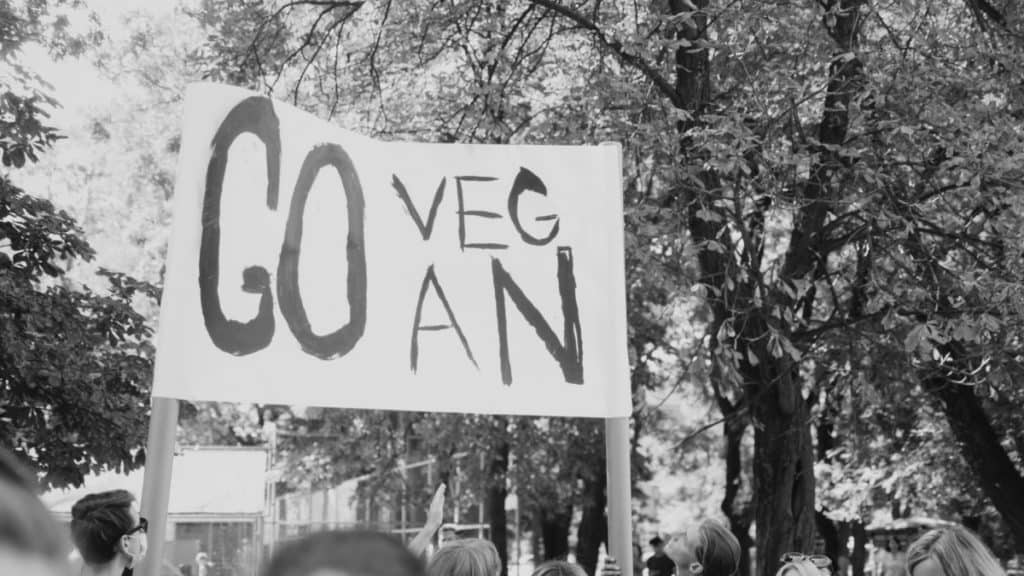
As with many subcultures, some of the loudest people are typically the most aggressive ones. So yes, you can find examples of vegans yelling at meat-eaters and shaming them. It happens.
But it’s such a small percentage of vegans who do that.
As far as vegans being terrorists, again, it’s an extremely small percentage of vegans who do anything illegal in the name of veganism.
Even in the cases where militant vegan activists are doing something illegal in the name of veganism, it’s usually destruction of property or trespassing to rescue animals.
It’s not like vegans are out there attacking human beings with weapons. I wrote about this more in my post about so-called “militant veganism.”
Animal Rights Activists as “Eco-Terrorists”
Interestingly, the government and corporate interests may play a role in spreading the stereotype of vegans as terrorists.
The Animal Enterprise Terrorism Act is a U.S. federal law, passed in 2006, that actually does legally categorize some animal rights activism as terrorism.
The Act does allow room for “peaceful protest” such as picketing, but many activists argue that it is too vague and sweeping in its wording, and it could infringe on the 1st Amendment rights of protesters.
There are also “Ag Gag” laws that have been passed by several states. These laws allow protesters to be arrested for filming and documenting what’s happening inside of slaughterhouses and factory farms.
4. Vegans are negative, depressing people.
Some people associate veganism with dwelling on all the things that are wrong with the world: Vegans are so negative, they won’t let me eat my dead animals in peace!
Don’t get me wrong—many vegans do feel strongly about what is happening to animals. So outrage and disgust are common emotions that many vegans feel in the process of learning about animal agriculture and deciding to go vegan.
But that doesn’t mean all vegans are going to go on and on about the bad things in the world as a daily habit.
Generally speaking, vegans are people who have decided to do something about the bad in the world. We are constructive and action-oriented. We are trying to actually line up our behavior with our values. That’s very different from being aimlessly negative.
In addition, many vegans recognize that, although there are massive amounts of suffering in the world, we do live in one of the best times in human history.
Factory farms are one of the excesses of capitalism and the industrial revolution. But the clock is ticking for them. People are realizing how nasty and awful they are. Awareness is spreading, and the alternatives are growing.
Overall, being vegan usually just means having your eyes open to the fact that there is a better way. And yes, that includes acknowledging and even calling attention to problems with the current way society operates.
But if you’re a vegan, it doesn’t mean you’re a “negative person” overall. You’re a problem solver. You’re passionate. You believe in your convictions and values, and you’re committed to them. You’re not just “negative.”
5. Vegans are pretentious, virtue-signaling know-it-alls.

This is a hard one. The truth behind it is that many vegans are passionate. And that passion can sometimes come across as “holier than thou.”
It’s easy to come across as pretentious without intending to, and I think that’s often what happens with “pretentious” vegans.
When you become aware of the massive suffering that animals encounter on factory farms—or the environmental destruction caused by animal agriculture—it can feel like your eyes have been opened for the first time.
As a result, you start to feel that other people just need to open their eyes, too.
As a new vegan, you want to be like the concept of a “Bodhisattva” in Buddhism—a person who has attained enlightenment and then comes back to help everyone else achieve it, too.
Without trying, you can come off as “preachy” or “holier than thou.” I’m pretty sure I have been guilty of this in the past.
Vegans and Virtue Signaling
With the rise of social media, the term “virtue signaling” has become more common, and vegans are among the people most often accused of it. Personally, I know I’ve been accused of it.
But while some vegans may be arrogant or rude in their moral proclamations, many of us are just passionate and want to share what we’ve learned.
We want to contribute to the collective learning and progression of the human spe