

 Tyler McFarland on December 21, 2022
Updated on November 8, 2023 Reviewed and fact-checked Found a mistake? Let us know!
Going vegan can often lead to a positive body transformation, especially weight-loss. But personally, I didn’t automatically get a six-pack simply by going plant-based. So, what additional steps are needed in that case? That’s what we’ll discuss today.
Some people will get a visible six-pack after a few months of eating vegan, as vegan diets often cause weight loss. However, if you’re vegan and you still want better abs, there are many additional tactics you can use. These include eating more vegetables, intermittent fasting, and most of all, calorie tracking.
Below, I’ll cover everything you need to know about getting a six-pack on a vegan diet. I’ll also share my own personal experience achieving this goal. Then I’ll cover a few related questions you might have about vegan muscle growth in general on a plant-based diet.
The Main Key to Six-Pack Abs: Fat Loss

For almost everyone who’s trying to get more visible abs, the key is shedding the layer of fat currently hiding them.
Most of us already have enough muscle in our abs that we could at least slightly see them if our body-fat percentage was low enough.
There’s a common saying that “abs are made in the kitchen.” From my experience, that’s true. Exercise can help, but diet is the key for achieving fat-loss that reveals your abs.
A vegan diet is good for fat loss because it’s often fewer calories, even without trying. Many people lose weight naturally when they go vegan. And if you cut out processed junk foods, too, then a vegan diet especially tends to cause fat loss.
So, for some of you, going vegan may naturally lead you to a six-pack, and you won’t necessarily have to change anything else specific about your diet or exercise habits.
But for me personally, and for many people, a vegan diet doesn’t get you all the way to a clearly visible six-pack. I’ll cover more on the details of what worked for me below.
When a Vegan Diet Alone Isn’t Enough to Get You a Six-Pack…
As I mentioned above, vegan diets tend to be lower in calories, so they often naturally lead to fat loss. But if you need even more fat-loss power, you can add some of these additional fat-loss tactics to your diet.
You don’t need to use all these fat loss tips below. But add a few of these tips together, and you will likely see results over the coming weeks or months:
- Eat more vegetables, especially green vegetables. Eat a lot of them. Fill at least half of your plate with veggies at every meal. Then, even if you stuff yourself, it’s mostly just fiber and water and nutrients—all good stuff, not a ton of calories.
- Drink a lot of water. If you normally drink soda, juice, or other calorie-rich beverages, switching to mostly only water can cause weight loss. Mineral water, sparkling water, or other zero-calorie beverages can also work. Plain water is the cheapest and probably the healthiest.
- Intermittent Fasting (IF). In practice, this often just means skipping breakfast, only eating between noon and 8pm (or an even smaller window, like 4pm to 8pm). If you get hungry during the “non-eating” times, you can drink sparkling water to hold you over. Some people enjoy how they feel during a fast, but others don’t. You can try it out and see how you feel.
- Switch from processed grains to whole grains. Whole-grain bread can help you get full on fewer calories than white bread. The fiber is also healthy for other reasons. The slower-digesting carbs won’t spike your blood sugar as much. Likewise, switch from white rice to brown. Switch from white pasta to whole-grain.
- Eat soup. Soups are generally low in calories, and because of their temperature, they are usually eaten slowly at the beginning of a meal. This slow, low-calorie addition to the beginning of a meal has been shown to reduce the average amount someone will eat during the rest of the meal.
- Eat from a smaller bowl/plate. For me, I always finish whatever I put on my plate. So part of my solution for portion control is using a smaller bowl. Then I serve myself less and avoid overeating just because the food is sitting in front of me.
- Exercise. Exercise can certainly add in your fat loss. Strength training can help raise your resting metabolic rate to increase fat burning all throughout the day. Cardio, whether running or even just walking, can also massively help. Personally, I try to get over 10,000 steps a day when “cutting” for a six-pack.
Many people find that adding a 1-hour walk to their routine every morning is the best way to accelerate fat loss. You can even listen to audiobooks so you’re learning while getting that exercise.
All of the above tips can help you lose fat and reveal your abs… And I’ve even expanded this list in another post here, if you want even more vegan fat-loss ideas. But I’ve been saving the most effective strategy for last. Here it is:
The #1 Most Sure-Fire Way to Get a Six Pack
I saved this for last because I know a lot of people won’t want to do it. But it’s actually the most certain to work, because it’s the most objective and precise: Count your calories using an app like Cronometer.
Of course, many people hate counting calories. But I swear, it has made all the difference for me in getting those abs.
Sure, it takes a little time and effort. And it may not be right for everyone. But it does give you actual data—numbers—that you can go off of. And that’s priceless when you’re trying to troubleshoot a fat-loss plateau, for example.
Using an app like Cronometer, you can enter all the foods you’re eating. And you can save the meals you regularly have, so you can quickly enter them again. But what number of calories should you aim at each day?
Calculating Your Calorie Deficit
One pound of fat is around 3,500 calories. So if you eat at a deficit of 500 calories per day, that will usually result in around one pound of fat loss per week.
That is a common, healthy speed of fat-loss to shoot for, and you may achieve it without even feeling too hungry along the way.
If keeping a 500-calorie deficit per day is too difficult, you can try for just a 250-calorie deficit. That should result in a half-pound of fat-loss per week. So it takes a bit longer, but it still works.
Smaller calorie deficits often allow you to keep effectively building muscle at the same time, if you’re strength training. So some people prefer a smaller deficit.
You can calculate the baseline of calories you burn every day using a calculator online. And then just keep your daily intake a few hundred calories below that.
The number you’re looking for is your “Total Daily Energy Expenditure” (TDEE). That’s how many calories you burn in a day. It differs based on a few factors, mainly body size. Here’s a free TDEE calculator you can use.
Tracking Your Progress on the Way to a 6-Pack

There’s a common saying: “What you measure, you improve.”
That’s part of why I like tracking calories—but I also track my weight and, less frequently, other measures of body-fat percentage.
If you’re weighing yourself to track your progress, you should weigh yourself every day, not just once per week. Then each week, calculate the average for that week. This is much better than weighing yourself once per week. Here’s why…
As you’ll see for yourself when you get on the scale each day, your weight actually goes up and down kinda randomly day to day.
The overall trend should be gradually going down. But some days, it’ll go up a pound or two because you ate a salty meal and now your body is temporarily holding onto more water.
So, don’t worry about the day-to-day fluctuations. Pay attention to the average for each week.
Tracking your weight is simple enough, but how do you calculate body-fat percentage and track that?
Tracking Body-Fat Percentage
Your “body fat percentage” is probably the one number that best represents how lean you are, and therefore how visible your abs will be.
Usually, under 15% body-fat on men, your abs are pretty visible, depending on the angle, pose, and lighting. Around 10%, they become clearly defined. Most people who want a six-pack should probably shoot for 10% to 13%.
But measuring your body-fat percentage can be tricky. Most methods are not super accurate.
There are actually some scales that calculate your body-fat percentage with an electrical signal. They are convenient and nifty, but I don’t really recommend them. I got one and found it to be unreliable.
Instead, I recommend two simple and affordable tools: Measuring tape + body-fat calipers.
Specifically, I recommend the Accu-measure calipers (very affordable on Amazon) and the MyoTape body measuring tape (also very affordable on Amazon).
These are the industry standard, each with thousands of reviews you can read on Amazon. They’re “cheap,” but they work.


It may take a little while to get confident with using these measuring tools. But there are many tutorials online. So, what measurements should you track?
These are 3 easy ones you can track without any assistance:
- Inches around your waist. With the measuring tape, measure at the fattest point, so around your belly button. Don’t suck it in or push out, just be relaxed.
- Skin-fold on your abs: Use the body-fat calipers to measure how thick your skin-fold is about 1 inch to the side of your belly button, pinched side-to-side.
- The “suprailliac” skin-fold: This is a skin-fold just an inch or so above your hip bone, so on the side of your belly.
There are calculators online where you can calculate your body-fat percentage based on various caliper readings around your body. But I stopped using those after a while.
The truth is, you don’t need to know your exact body-fat percentage. All you need to do is make sure that those 3 measurements are gradually going down, until your abs look the way you want.
If you want to know your body-fat percentage as a number, I recommend just using pictures as a guide. Or there’s a video I’ve embedded down below, in the section on how long it takes to get a 6-pack.
Side Note: This is the best free video introduction I’ve found on adopting a plant-based diet—the right way. You’ll learn how to lower your risk of cancer, heart disease, type-2 diabetes, Alzheimer’s, and obesity—all with plants. Watch the free Masterclass here.
How Much Does Exercise Matter for Abs?

Exercise is less important than diet for getting six-pack abs—but it can still play two valuable roles:
1. Exercise can add to your calorie deficit to speed up fat loss. If fat loss is mostly determined by “calories in” versus “calories out,” then it makes sense that it helps to increase your “calories out” by exercising.
A good long walk, jog, or bicycle ride can add 300 or more calories to your deficit. Or it can add to the amount you can eat while still maintaining the same deficit.
Strength training not only increases your “calories out” due to exercise on that particular day. Building muscle also increases your Basal Metabolic Rate (BMR), which is the amount of energy your body burns each day just to sustain itself.
Basically, your body needs to “feed” that new muscle it has, so some calories go toward that every day. So, that’s another way that exercise can help with overall calorie burn.
2. Exercise can build your abdominal muscles so they’re more easily visible. We all have ab muscles to some degree already—abs are needed for daily tasks we all perform. But if you strengthen them, they can be visible even with slightly more fat covering them.
Therefore, it does make sense to do some ab exercises as you’re trying to get your six-pack.
I’m not going to include tons of “how-to” information for these exercises here. Those are easy to find on YouTube. But here are some exercises to consider doing besides your basic crunches and sit-ups:
- Hanging knee raises or leg raises (my favorite, great for lower abs—requires a bar to hang from)
- Mountain climbers
- Burpees
- Bicycle crunches
- Planks and side planks
- L-sit
Building a Muscular Vegan Body, Not Just Abs
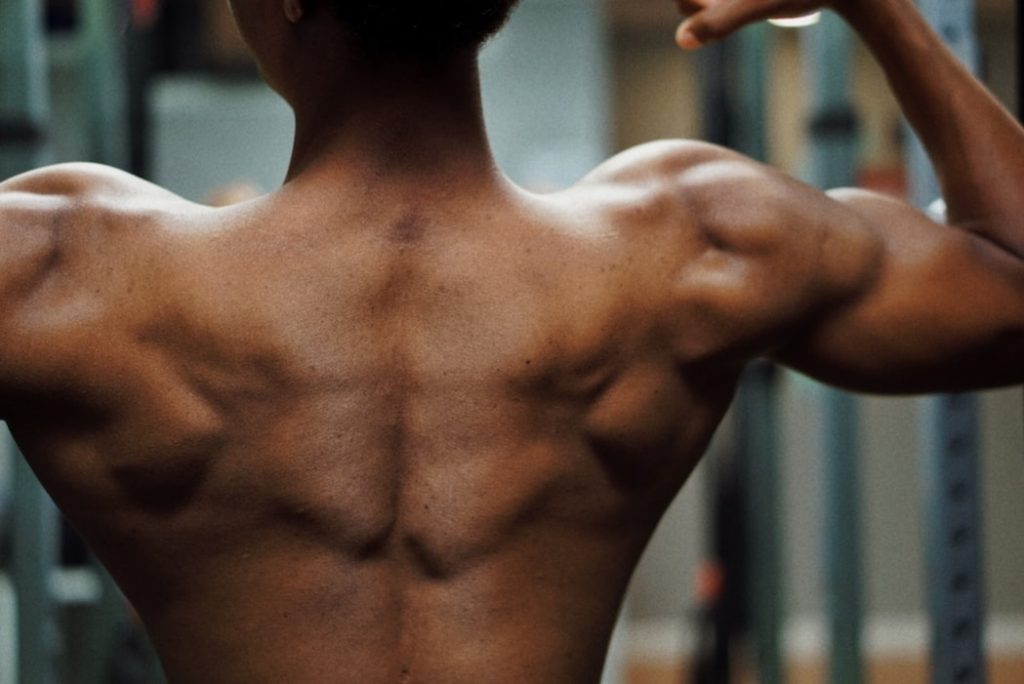
If you think about the typical physique that people want, especially men, abs alone don’t complete the whole picture.
Usually, when people say they want six-pack abs, what they really want is a strong, lean physique in general. It’s that combination of strong and lean that people want.
To get your abs visible, it’s the lean part that especially needs to be honed. But I’ll cover some general quick principles here for building out your strength and muscle mass around your whole body, as well, to make a well-rounded vegan physique:
- Focus on compound exercises in your strength training. Compound exercises involve multiple muscle groups working together, and they allow you to lift more weight. The generally build more muscle more efficiently than “isolation exercises,” which only target 1 muscle. Especially try doing some of these: Bench press, squat, deadlift, overhead press, pull-ups, rows, dips, and push-ups.
- Get enough protein. More on vegan protein sources below, but 0.8 grams per pound of body weight per day is the rule of thumb I’ve used. And I’ve seen real differences when implement high-protein vegan meal plans.
- Progressive overload: Keep a workout journal so you can track your use of progressive overload. Progressive overload is the simple idea that your muscles grow in response to increased demand. So, gradually keep increasing the amount of weight, reps, or sets over time.
- Rep ranges: If you use a light weight, you can do 20-30 reps of an exercise, but if you use a very heavy weight, you can only do 1 rep. Without getting into all the details here, if your goal is building muscle mass, I recommend choosing weights that allow you to do between 4 and 12 reps in a set for most exercises.
- Length of workouts: A 30- to 60-minute workout is plenty, especially if you’re new to strength training. If you spend 2 to 3 hours in the gym, you risk overtraining, which is difficult to recover from. Do an efficient workout with at least a couple compound exercises (listed above), and finish within about an hour.
If you want more advice on muscle building, you can follow some vegan fitness and bodybuilding athletes. They make Youtube videos, podcasts, and Instagram posts with this information tailored specific to a vegan lifestyle: Derek Simnett, Frank Medrano, Nimai Delgado.
Also, he’s not a vegan, but I honestly think Greg from Kinobody has some of the best advice when it comes to fitness for the male “movie star body” look.
How to Get Enough Protein to Build Muscle as a Vegan
If you read around the internet about how much protein is required to build muscle on a vegan diet, you will see wildly different numbers suggested.
I don’t think the science is very conclusive at this point. But the most convincing guideline to me is 0.8 grams of protein per pound of your bodyweight.
