

 Tyler McFarland on May 21, 2020
Updated on November 8, 2023 Reviewed and fact-checked Found a mistake? Let us know!
Every movement needs a logo—and the vegan movement has many. As a vegan, you should be aware of the most common ones used widely on menus, food packages, patches, and flags.
From vegan emojis to official “vegan certified” trademarks, this post will cover all the vegan symbols, logos, labels, and signs you should know!
Common Elements in Vegan Symbols
There is no single official “vegan symbol” or “vegan logo.” Instead, there are many. However, there are common elements shared between most of them:
• The letter V. Most vegan icons include the letter V. Sometimes, they also include other letters, such as: “VE.” “VG.” “VGN.” Sometimes on restaurant menus, “V” will mean vegetarian, while “VE” means vegan.
• A leaf or plant. Very commonly, a leaf or plant will be used as a symbol of veganism or vegetarianism, too. Usually it looks something like a spinach leaf. But also see the section below on the vegan plant emoji.
• The color green. As another reference to leaves/plants, the color green is very often associated with veganism or vegetarianism. Probably more than half of all vegan companies or organizations include a green color in their branding.
Two Classes of Vegan Symbols
Vegan symbols or logos can be divided into roughly two categories:
1. Logos used to promote the vegan movement: These symbols are meant to be shared widely, printed on shirts, patches, flags, and the like. They’re often included in profile pictures or usernames on social media to show support for vegan ideals. Such symbols are often in the public domain.
2. Logos used to denote vegan products: Whether on food packaging or restaurant menus, symbols are used to denote vegan options. These symbols act as shorthand, relieving vegans of the need to check ingredients. Many vegan certification symbols on food packaging are trademarked—you must apply for the right to use them.
Now let’s get into some of the specific vegan symbols used widely today!
V in a Circle
There are several vegan V logos that include a circle around the V. The first one to discuss is just the plain and simple V enclosed in a circle. It is typically a sans serif V.
It can be written in type as Ⓥ. This is a Unicode character, which was created in 1987 and is recognized by most computers.(See below for “how to type the vegan symbol.”)
This symbol is parallel to the enclosed A or E logos of anarchism and egalitarianism. (The anarchism logo is the much more popular one.)

Of all the vegan symbols, this simple enclosed V has connotations of ethical veganism due to the similarity to the anarchist symbol.
The Kosher V vs the Vegan V

When you see a V in a circle, it should not necessarily be assumed to denote vegan food. There is actually a kosher food certification agency (Vaad Hoeir) that uses a V in a circle to denote kosher food.
Vaad Hoeir’s V is set in a serif font rather than the sans serif typically used for the vegan V in a circle.
I actually wrote a whole blog post comparing kosher and vegan. But suffice it to say, there are many kosher foods that are not vegan. So you would not want to assume that a food package containing this kosher V is vegan.
Other times, a V in a circle may be used to just mean “vegetarian” (but still including eggs or milk). So, while the V in a circle is often used to mean “vegan,” you don’t want to depend on that.
Side Note: This is the best free video introduction I’ve found on adopting a plant-based diet—the right way. You’ll learn how to lower your risk of cancer, heart disease, type-2 diabetes, Alzheimer’s, and obesity—all with plants. Watch the free Masterclass here.
V in a Heart

Sometimes a V in a heart is also used in vegan symbolism. This is the case with the Vegan.org certification, one of the most common and trusted logos denoting vegan products, especially in the U.S.
The Vegan.org certification logo denotes that the product contains no animal ingredients and is not tested on animals. Over 1,000 companies and products carry the logo today.
This certification is bestowed by the Vegan Awareness Foundation (another name for Vegan Action). The logo is trademarked, and it should not be used on your own products without applying for and being approved for certification.
V Symbol With a Leaf
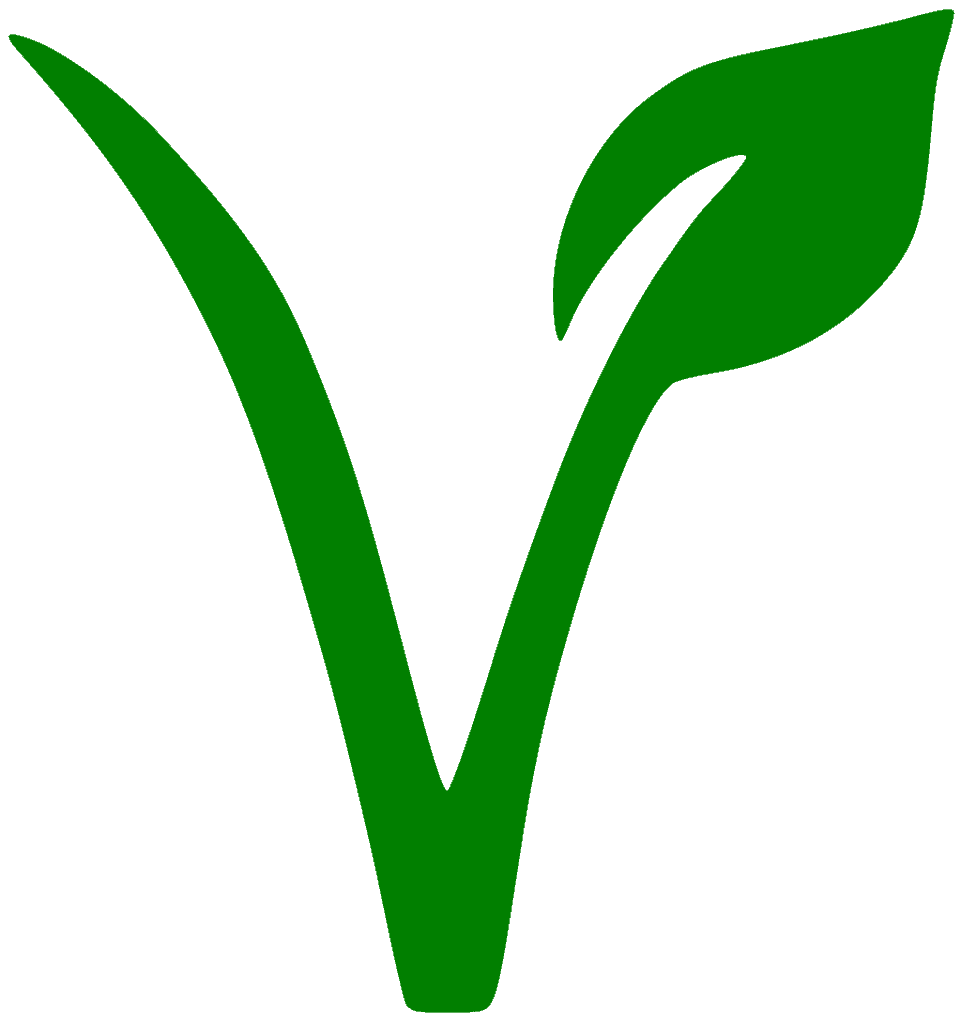
Several versions of vegetarian and vegan symbols include a leaf branching off one side of the V.
One specific example of this kind of logo is the European vegetarian label, created by the European Vegetarian Union (EVU).
The EVU’s website has vector downloads of this V logo, along with an explanations for how to type the icon and show it on your website (with HTML).
But there are other versions of this vegan V with a leaf. Some include leaves on both sides of the V. Some include the V with a leaf and the rest of the word “vegan” written out, too.

The Fork Bracelet

Another vegan symbol today is a fork bent into a bracelet. This is not just a symbol of veganism in general, however. This denotes adherence to The Liberation Pledge, which is a more strict stance I explain in my blog post all about it.
People who take The Liberation Pledge commit not only to being vegan but also to refuse to sit at tables where animals are being eaten.
Many adherents of the Pledge wear a bent fork around their wrists as a bracelet. Usually, this is a real metal fork. But I’ve also seen rubber wristbands featuring a fork graphic on them, as well as people getting tattoos of a fork bent around their wrist.
Forks can carry vegan symbolism in general, too. One of the most famous plant-based documentaries and cookbooks is called Forks Over Knives. There are several vegan businesses and organizations that use a fork in their logo.
Basically, a fork is one of the simple tools that vegans are using to change the world. So it makes a great logo.
The Vegan Flag
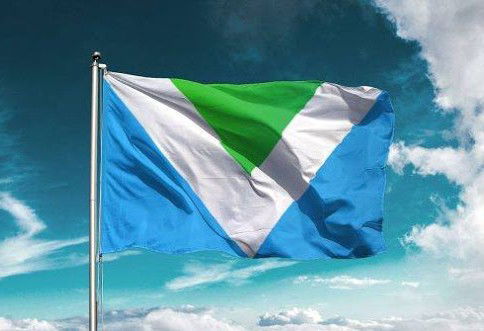
The vegan flag is composed of a white V separating a green and blue field. It was designed in 2017 by an international group of designers launched by Gad Hakimi of the Animal Liberation Front in Israel.
The blue in the vegan flag represents marine animals and flying animals. The green represents land animals. The white V represents veganism, as well as the equality and unity between humans and nonhuman animals.
The V is also an inverted pyramid, which symbolizes the ability to do the impossible (to make a vegan world!).
This page on the official website has more background on the flag, the exact color codes, along with guidelines on how it can be used and adapted to different purposes and presentations.
The Vegan Coat of Arms

I was surprised and delighted to find this just recently—the official vegan coat of arms. It’s downloadable here.
It was designed by Dutch artist Maria Tiqwah, who has released it into the public domain.
That means you can use it for any purpose legally. Go make t-shirts of it, make posters of it, whatever—just spread it far and wide!
The vegan coat of arms depicts a triumphant cow up on two legs next to the vegan flag. A small piglet and rooster are also present.
A scroll reads: “Have Courage ~ Be Kind ~ Go Vegan.”
The Paw and Fist (“Animal Liberation, Human Liberation”)
