

 Tyler McFarland on July 9, 2021
Updated on November 8, 2023 Reviewed and fact-checked Found a mistake? Let us know!
Got vegan farting problems? Well, I’ve actually experienced it myself, so I feel your pain. But it doesn’t have to be so bad. There are many quick adjustments you can make to stop farting so often.
The quickest solution to vegan farting for many people is to take digestive enzymes like Vegan Bean-zyme with meals. Other solutions include reducing problem foods like beans and cruciferous vegetables, changing details in your food preparation (like draining and rinsing beans).
I’ve actually got 17 tips for how to stop smelling up the room as a vegan. If you want to jump right into the tips, you can click here to scroll down the page. Or you can just keep reading, and I’ll explain why vegan gas happens, and what foods usually cause it most.
Why Do New Vegans Fart More?
Many new vegans experience a temporary increase in gas when going vegan. This is due to increasing your fiber intake suddenly.
Once your body gets used to the new higher fiber levels (typically in a few weeks), your gut will likely adjust to it. Then the gas may decrease naturally. So you may just need to wait it out—or be more gradual when adding high-fiber foods at the start of your vegan diet.
If you identify a main problem food or two that’s causing your gas, you can remove that specific food for a while, as you’re getting adjusted. Then you can slowly reintroduce it later.
But some people experience long-term gas from common vegan foods, too, especially beans. And that may not go away on its own. To address that, you may need some of the strategies below.
Fiber: The Main Culprit Behind Vegan Farting
The average American eats only 15 grams of fiber per day. This is below the recommended daily intake of 30+ grams (depending on your bodyweight). A healthy vegan diet can get you anywhere between 30 and 100 grams.
Meat has no fiber, at all. So for many new vegans, the change in fiber intake is dramatic at first. If you replace a steak or chicken breast in your diet with a can of beans, you’re literally going from zero fiber to over 20 grams for that meal.
Increasing your fiber has great benefits for your health. It can help with weight management, reducing cholesterol, increasing insulin sensitivity, and increasing mineral absorption.
More fiber also helps with your long-term health—it’s widely believed to reduce the risk of type-two diabetes and colon cancer.
But a big shift in your fiber intake can also cause gas—let’s understand why.
Why More Fiber Can Cause More Gas
Fiber is not actually digestible as a source of calories by you. Instead, it just sweeps through your system and cleans things out. It arrives intact in your large intestines, which is the end of the line (before the toilet).
But that extra fiber, along with certain other carbs I’ll cover below, can become food for the bacteria in your gut. When these bacteria eat the fiber (via fermentation), they produce gas as a byproduct.
So you get gas in your intestines. This gas can cause farting—or combined with the fullness also caused by fiber, it can give a feeling of bloating.
Your body will usually adjust to the increased fiber. It will start digesting more of the food before it reaches the large intestine, and the bacteria in your gut will change based on your diet.
Those changes should reduce gas. But it may take a few days or a few weeks for that adjustment to take place.
Soluble Fiber vs Insoluble Fiber
It’s not all fiber that causes us to fart more. You’ll often see specific numbers listed for “soluble fiber” and “insoluble fiber” on nutrition labels. Soluble fiber causes more gas.
Insoluble fiber is a kind of fiber that doesn’t absorb water. It passes through your gut without becoming food for those gas-producing bacteria. But soluble fiber absorbs water and lets the bacteria feed on it.
Major sources of soluble fiber include the following:
- beans
- psyllium fiber supplements
- many fruits
- beets
- carrots
- oats (including in cereal or baked goods)
But before you go cut out all (or even most) soluble fiber from your diet, read the next section on how prebiotic soluble fibers can actually help reduce the bad smell of your farts on a vegan diet.
Finding the right balance between not enough and too much soluble fiber may be key.
What Causes Bad-Smelling Farts on a Vegan Diet?
The odor of our farts may actually be more important for our comfort and pride than the volume of gas we expel.
One of the key causes of smelly farts is the amount of sulfur you consume. Sulfur has that rotten-egg smell that is so common to bad farts.
When looking at vegan foods, sulfur is found in:
- cruciferous vegetables like broccoli and cauliflower
- almonds and peanuts
- dates and other dried fruits
- wheat pasta
- wine and fruit juices
So to reduce the bad smell of your farts, you can try to limit these sulfur-containing foods.
Another factor that can influence the sulfur smell in your farts is whether you’re consuming enough prebiotics. Prebiotics are food for beneficial bacteria in your intestines.
How prebiotics affect farting can get complicated. This is because there’s a whole chain of cause-and-effect. It’s also confusing because “prebiotics” overlap with the “soluble fiber” and “oligosaccharides” that can cause more gas.
I’ll go into more detail below in tips 3 and 4, but the takeaway point for now is just that you actually do want some prebiotic soluble fiber in your diet, to reduce smelliness of your farts (and for other aspects of gut health). So don’t go too extreme in cutting out fiber.
Side Note: This is the best free video introduction I’ve found on adopting a plant-based diet—the right way. You’ll learn how to lower your risk of cancer, heart disease, type-2 diabetes, Alzheimer’s, and obesity—all with plants. Watch the free Masterclass here.
17 Tips to Stop Farting So Much on a Vegan Diet
Ok, here are the practical tips. I’ve tried to put the most important and helpful tips near the top. So I would recommend starting with those. But you may want to try a few.
1. Introduce High-Fiber Foods Slowly.
Especially introduce beans slowly. Don’t go for full cans right away.
Some guides suggest adding beans to your diet with just a few tablespoons per day. It might sound funny to measure beans in tablespoons—but hey, whatever works! If you’re consistent, your body should adjust to the fiber.
You can use an app like Cronometer to monitor your total fiber intake each day and gradually increase it. Other high-fiber foods to specifically be aware of would be whole grains like whole wheat.
2. Keep a Food Journal to Identify Problem Foods.
This is pretty simple advice, but it may be the most impactful. If you can identify which foods cause gas for you personally, that can make it much easier to steer clear of those.
Even within the category of beans, you can notice whether large beans or small beans tend to cause you more gas. Are lentils or black beans worse for you personally? (Both are pretty bad for me, but rinsing them helps a lot.)
For me, I found that beans, raw cruciferous vegetables, and whole-wheat often cause gas. Also, sometimes peanut butter gives me trouble.
Again, an app like Cronometer can help you log all your foods. But you can also keep track on paper or a simple note-taking app on your phone.
You can always try to reintroduce your problem foods back in later if you want, gradually building up your ability to tolerate them.
3. Take Digestive Enzymes.
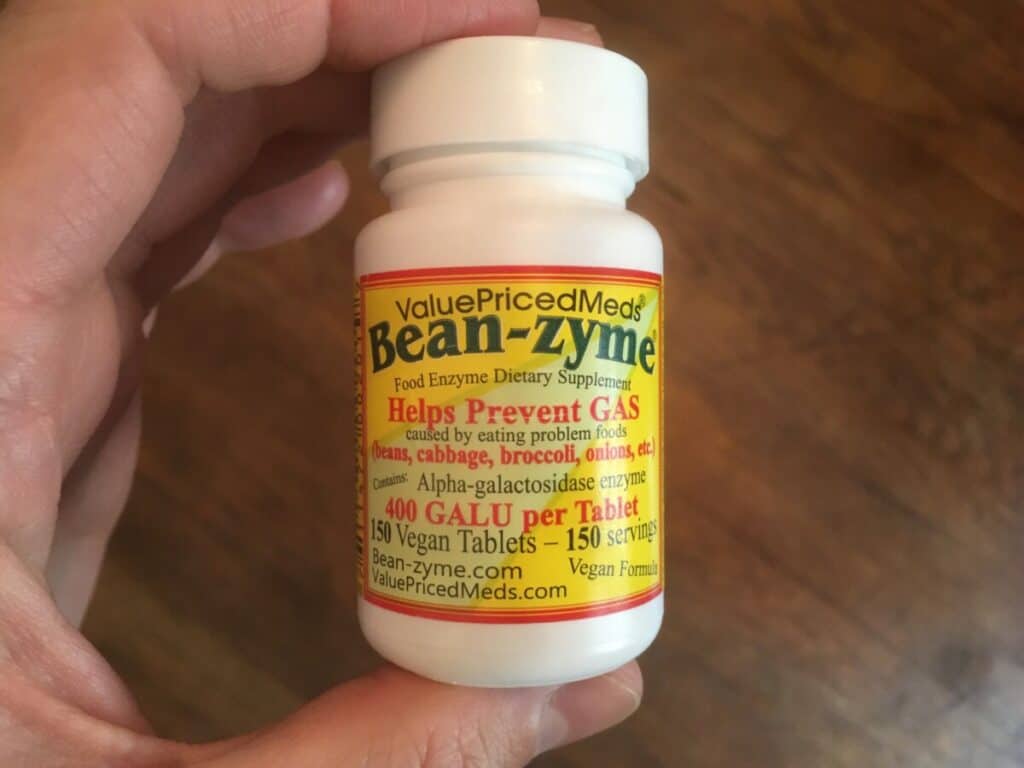
This may be the magic bullet for many people. It’s a simple and direct solution. Many of the carbs that cause gas on a vegan diet can be better broken down with a supplement of digestive enzymes.
The most common choice for vegans is Vegan Bean-zyme (Amazon link). It’s simple and cheap, and it’s shown to be safe. No weird side effects or anything.
The main ingredient is alpha-galactosidase. It’s the same active ingredient in Beano. (But Beano isn’t fully vegan.)
Alpha-galactosidase helps break down those troublesome fibers and carbs that cause gas when they make it to your gut undigested. It’s been shown in studies to reduce intestinal gas.
Other enzymes exist that are “full-spectrum” and include other enzymes, too. But I think it makes sense to start with alpha-galactosidase since it’s the enzyme used in the leading brand (Beano).
Full-spectrum enzymes options are typically more expensive, too. Bean-Zyme is actually really affordable. But if you try that and it doesn’t help, maybe a full-spectrum option will help.
Typically, you just take one or two of the enzyme pills with your meal. Pretty easy.
Note: Diabetics should ask their doctor before using alpha-galactosidase, as the increased breakdown of carbs can potentially raise your blood sugar. People with mold allergies should also avoid it because of the way it’s produced. And lastly, it shouldn’t be taken by people with the rare genetic disorder “galactosemia.“
4. Eat Probiotics and Fermented Foods.
“Probiotic” just means good bacteria. Taking probiotics can help your gut transition into a different kind of bacterial environment faster. This can help with gas.
There are certain probiotics that, with the help of prebiotics (covered in tip 4), create short-chain fatty acids like butyrate. These acids create an environment in your gut where sulfide-producing (smelly) bacteria can’t thrive. The result: Less smelly farts.
Some probiotic supplements use dairy in the culturing process, so look out for that. But many are 100% vegan.
Two things to look for in probiotic supplements are the count of “CFUs” (colony-forming units) and which strains of bacteria are included.
Lactobacillus acidophilus is one strain known to help stop gas. Bifidus (“Bifidobacterium”) is also helpful. But more strains, in general, is also considered helpful.
Here is the probiotic supplement I recommend (Amazon link). It has 20 billion CFUs per serving, from 12 vegan strains. It includes both the strains most commonly cited to help stop gas. Go read the reviews on Amazon—people have great results with it!
Fermented foods are another way to get more probiotics into your gut. When it comes to fermented vegan foods, look into sauerkraut, water kefir, kimchi, kombucha, tempeh, and miso.
One last note on probiotics: Be gradual in introducing probiotic foods and supplements! If you add a ton of them at once, you’ll probably have worse gas for that day. Ease into it. Give your gut a chance to transition.
5. Eat Prebiotics to Support the Probiotics.
Prebiotics can help reduce the smelliness of your farts by supporting the probiotics you already have.
If you’re following the chain of cause and effect, it’s like this: more pre-biotics —> more pro-biotics —> more short-chain fatty acids in your gut —> less sulfide-producing bacteria —> less smelly farts.
The takeaway point: You want prebiotic soluble fiber in your diet to reduce the smelliness of farts (and for other aspects of gut health, as well).

For prebiotic supplements, the most popular options are acacia fiber and inulin. These are usually sold as powders, and they’ve been shown to increase good bacteria in your gut over the course of a few weeks.
Here’s the acacia fiber I use: Heather’s Tummy Fiber (Amazon link). It’s organic and it has no taste. You just stir a little into a drink or food, and it helps support your good bacteria. Read the Amazon reviews—it’s a quality product.
Just start it slowly! If you take a bunch of acacia fiber at once, you’ll probably fart more for a while. (I say this from experience.) Be patient and build up gradually.
You can also get inulin fiber in foods like asparagus, Jerusalem artichoke, garlic, onion, leek, and chicory root.
You can also increase your intake of resistant starch, which functions as a prebiotic, too. For that, try eating more partially green bananas or, actually, cold potatoes.
Yep, cold potatoes! One form of resistant starch is formed when you cook potatoes and then cool them back down.
6. Soak Your Beans and Discard the Water.
Beans are perhaps the single worst food when it comes to gas. And they are central to most ways of eating vegan. You can be a healthy vegan without beans, but it’s worth incorporating them if you can. So why do beans cause gas for many people?
Beans and other legumes (peas and lentils) contain a type of carbohydrate called “oligosaccharides.” These oligosaccharides are not fully digested in your small intestine because most of us do not have enough of the enzyme “alpha-galactosidase” that breaks them down.
This leads to a situation where the oligosaccharides reach your large intestine intact, and they feed the bacteria there. As explained above for fiber in general, the bacteria ferment this undigested food, and the result is gas.
Typically, gas from bean consumption will decrease after regularly eating them for some number of weeks—but it can remain a long-term problem for some people. Then you need to use some of the bean tips in this article, and that starts with soaking your beans and discarding the water.
If you’re cooking your beans from dry, then you need to soak them overnight in water before cooking them. To decrease the gas-causing power of the beans, you should discard/change the water the beans are soaking in at least once.
Many of the oligosaccharides that produce gas with bean consumption will wash away with the water you soaked them in. This leaves you with less-gassy beans. Change the water multiple times for an even greater effect.
7. Rinse Off Your Canned Beans.
This was a big tip for me.
With canned beans, you just want to rinse away that “bean juice.” Rinsing off your canned beans helps remove excess oligosaccharides in the same way as soaking your dry beans.
So drain and rinse your canned beans well. This can also reduce the amount of salt, which will make the beans even healthier.
I found that I can eat a full can of beans without gas, as long as I rinse them well. But if I don’t rinse them… farts are on the way.
8. Cook Your Cruciferous Veggies.
Mentioned above for their sometimes smelly sulfur content, cruciferous vegetables include broccoli, cauliflower, brussel sprouts, kale, arugula, and bok choy. Well, the sulfur content is not the only potential problem when it comes to cruciferous veggies and gas.
Cruciferous vegetables also cause gas due to their raffinose content, which is a specific type of oligosaccharide. We can’t digest raffinose very well, and once again, it becomes food for our gut bacteria, and they produce gas as they ferment it.
But you can combat this. Along with taking digestive enzymes like alpha-galactosidase mentioned above, you can try switching from raw to cooked cruciferous veggies. When cooked, these veggies tend to cause a lot less gas for most people.
9. Drink More Water.
Water can keep things moving and bind to the fiber you’re eating. I don’t understand the mechanism as thoroughly as for some of the other tips, but many sources recommend drinking more water to reduce gas on a vegan diet.
In fact, some sources argue that you should keep increasing your water intake as you increase your fiber, or you should be especially sure to drink lots of water with your high-fiber meals specifically.